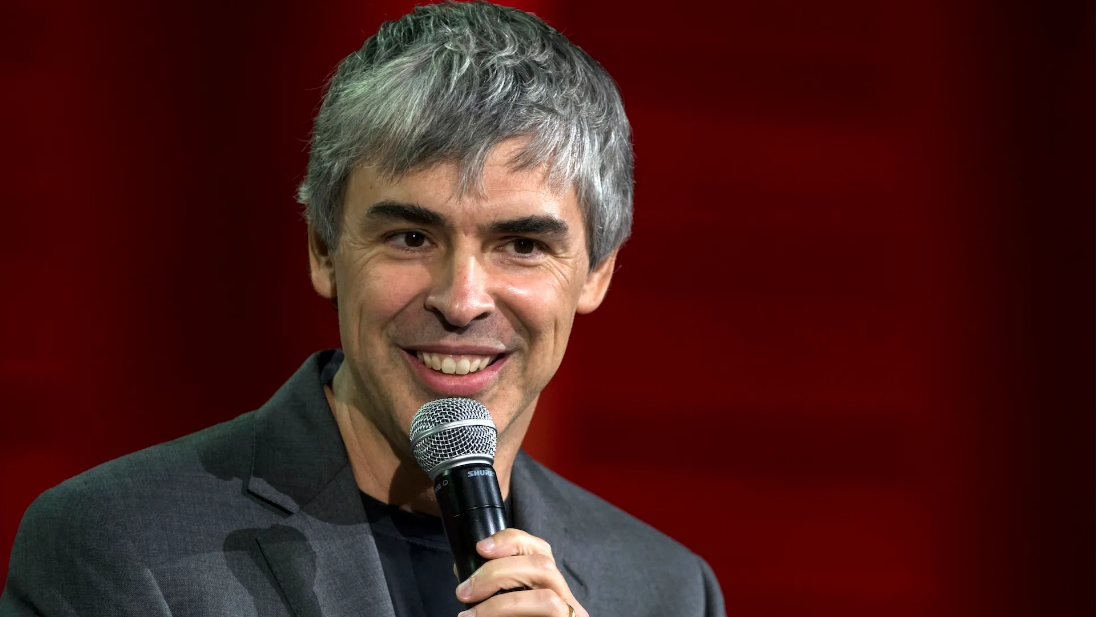
1973 – On 26 March, Larry Page is born in East Lansing, Michigan, the second son of Michigan State computer-science professor Carl Page and speech-language researcher Gloria Page.
1978 – Five-year-old Page is already cracking open radios and printers to see their guts, an early signal of the curiosity that will later colour every Silicon Valley origin story about him.
1989 – A summer at Interlochen Arts Camp fuses his love of music with computing, planting the seed for the algorithmic mindset he will refine at university.
Education
1991 – The University of Michigan admits Page; side projects such as an inkjet-printer plotter and a solar car now headline retrospectives on his undergraduate years.
1995 – He begins a computer-science PhD at Stanford and meets fellow graduate Sergey Brin, launching a partnership that soon dominates tech journalism.
1996 – Their crawler BackRub indexes 75 million pages, proving that relevance can be scored mathematically rather than curated by editors.
1998 – A $100 000 cheque from Andy Bechtolsheim prompts a leave from Stanford and opens a bank account labeled Google, Inc.
Career & Business
1998 – Google incorporates in Menlo Park; Page, as founding CEO, wires the office himself to stretch every dollar.
2001 – Veteran leader Eric Schmidt becomes CEO, while Page—still product chief—drills engineers on shaving milliseconds from search results.
2004 – Google goes public at $85 a share, finishing its first trading day worth $27 billion.
2005 – Buying Android reveals Page’s appetite for bets the outside world calls tangential.
2011 – He retakes the CEO job, reorganises teams around “simple, fast, beautiful,” and green-lights self-driving-car experiments.
2015 – Page and Brin launch Alphabet; he moves upstairs to run the parent company and gives moonshots like Waymo and Verily breathing room.
2019 – Day-to-day control passes to Sundar Pichai, though Alphabet’s dual-class shares leave Page firmly on the bridge.
2023 – Electric-air-taxi venture Kittyhawk shuts down; within months he bankrolls a hydrogen successor, turning a rare public failure into fresh R&D.
Politics
2013 – Page helps found FWD.us to push for high-skill immigration reform and broader STEM visas.
2016 – Alphabet spends $18 million lobbying Washington, much of it aimed at open spectrum and looser drone rules aligned with Page’s agenda.
2021 – He backs a carbon-tax initiative in Washington State, labelling climate change “the ultimate computational problem.”
2024 – Reports surface of quiet meetings with EU commissioners where he warns that over-zealous AI rules could crimp European competitiveness.
Wealth
2004 – IPO day instantly makes Page a billionaire.
2012 – Alphabet stock above $700 pushes his fortune near $20 billion and finances a $45 million Palo Alto compound.
2020 – Pandemic-era ad growth lifts his net worth to roughly $60 billion, per Bloomberg.
2023 – A generative-AI rally drives the tally past $100 billion, ranking him eighth worldwide.
2025 – Share buybacks and private bets on fusion energy nudge the figure to about $118 billion despite aggressive philanthropy.
Charity & Philanthropy
2004 – Google.org launches with $1 billion in stock, initially funding Wi-Fi projects across Africa.
2008 – Page honours his father with the Carl Victor Page Memorial Fund, underwriting hands-on PhD fellowships.
2014 – During West Africa’s Ebola crisis he pledges $25 million for vaccine logistics and charters supply flights.
2019 – Alongside Brin, he seeds a $300 million climate-tech fund that backs direct-air-capture start-ups from Iceland to India.
2023 – As his fortune tops $100 billion, the family foundation allocates another $1 billion to geothermal grids aimed at zero-carbon baseload power.
Family & Personal Life
1973 – The East Lansing newborn who will one day reinvent search enters the world.
2007 – Page marries Stanford biomedical scientist Lucinda Southworth, who keeps joint ventures out of headlines.
2009 – Their first child is born on a Caribbean island, a privacy tactic repeated with the second in 2011.
2021 – The family splits time between Palo Alto and Fiji; Page codes at dawn, paddle-boards with the kids, then logs into Alphabet board calls.
Scandals
2010 – EU regulators open an antitrust case over search-ranking bias; Page flies to Brussels and argues that “users vote with clicks.”
2019 – Project Nightingale raises alarms about hospital data-sharing; he orders an opt-out switch for patients within six weeks.
2022 – A U.S. Senate panel grills tech founders on tax deferral; Page notes $3 billion already paid and invites lawmakers to rewrite the rules.
2024 – Critics question his fast-track New Zealand investor visa during pandemic border closures; he counters by funding Pacific vaccine labs.
Honors & Recognition
2002 – MIT Technology Review places him in its TR-100 for pioneering large-scale link analysis.
2004 – The Marconi Society names him a Fellow for reimagining information retrieval.
2014 – The National Academy of Engineering elects him for “leadership in internet entrepreneurship.”
2022 – France awards him the Légion d’Honneur after he bankrolls AI institutes in Paris and Grenoble.
2025 – IEEE announces its Founder’s Medal will go to Page for merging quantum algorithms with classical data centres.
Awards
2004 – Time ranks him among the “100 Most Influential People,” only six years after Google’s birth.
2011 – The Economist grants him its Innovation Award in Computing for Android’s open-source disruption.
2020 – The Global Health Council recognises him with a Humanitarian Award for quietly chartering COVID-19 relief flights.
2023 – The Computer History Museum inducts him as a Fellow, noting that nearly every internet user touches his algorithms daily.
2025 – The Breakthrough Energy Prize honours his multi-billion-dollar investments in fusion and geothermal power, funded from his own balance sheet rather than waiting for government grants.