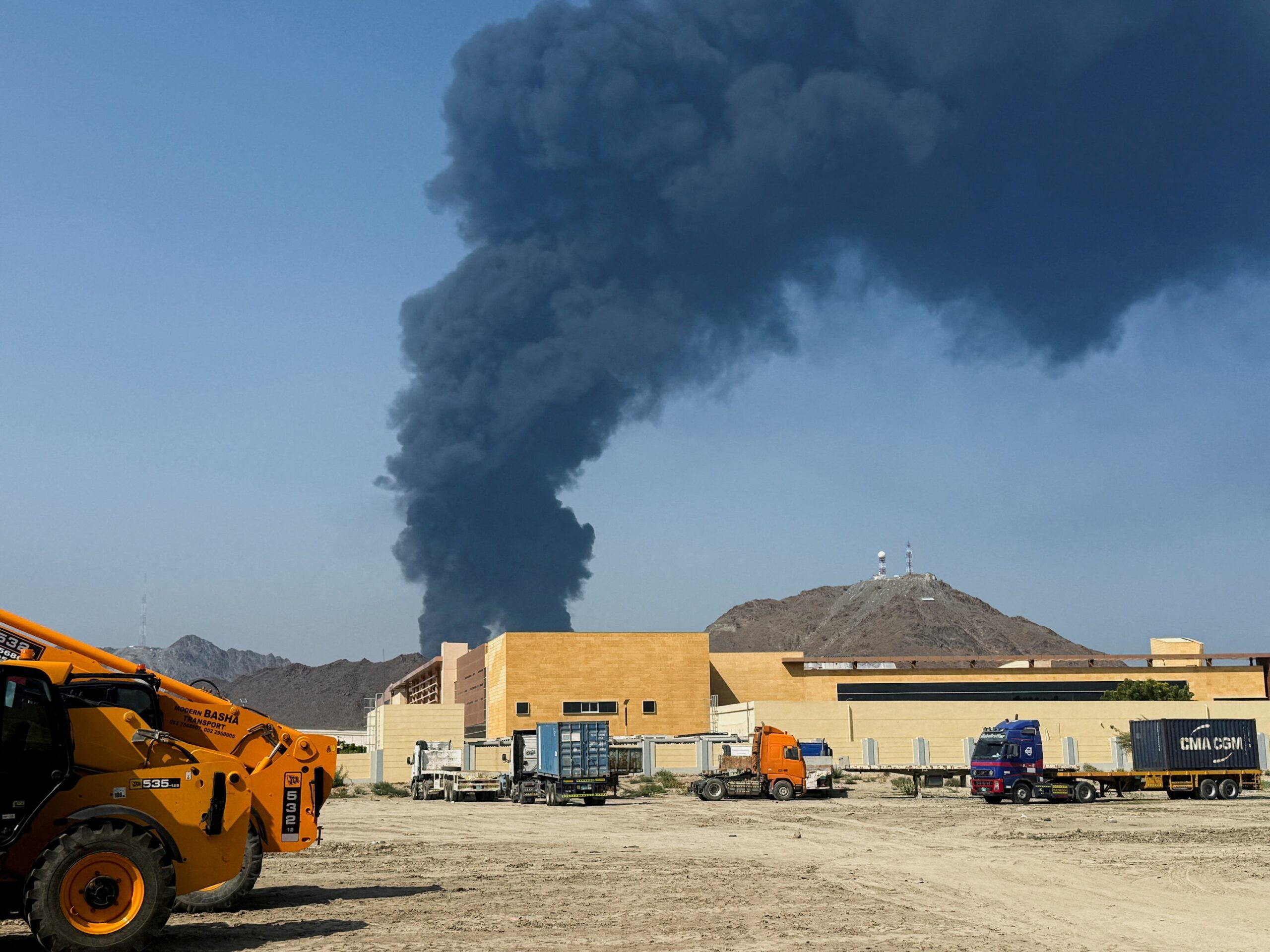
In recent days, as Iranian attacks on Fujairah escalated, the strategic significance of this port located on the UAE’s eastern coast has become increasingly clear.
Numerous drone assaults have targeted storage, bunkering, and port infrastructure, with at least three incidents occurring over a short span. Although operations have largely resumed, the frequency and intensity of these attacks highlight Fujairah’s vital role due to its unique geographic position.
Situated outside the Strait of Hormuz chokepoint, which is essentially impassable for typical traffic from the Gulf, Fujairah serves as a crucial alternative route. This makes it highly valuable from a geopolitical standpoint.
Through the Habshan-Fujairah pipeline, Abu Dhabi is able to export a substantial amount of crude oil directly to the Arabian Sea, bypassing Hormuz entirely. This capability is increasingly essential for maintaining oil exports in the current situation.
Estimates suggest the pipeline could handle up to half of the UAE’s oil production to Fujairah.
Beyond serving as a bypass route, Fujairah has evolved into a significant energy hub, recognized globally for its oil storage, blending, and logistical operations over the last two decades.
The storage capacity in Fujairah is around 70 million barrels, with ongoing projects aimed at further increasing this figure.
Crude oil from Adnoc fields, processed petroleum products, and supplies from third parties converge at this location, bolstered by infrastructure that promotes efficient management and redistribution.
The facilities in Fujairah are modern and advanced, supported by investments from both Abu Dhabi and private entities. The port’s pipeline systems, single-point moorings, and deepwater docks facilitate the loading of very large crude carriers without the draft restrictions that limit many other regional ports.
This infrastructure enables significant oil throughput even in challenging conditions.
Fujairah is also one of the leading bunkering hubs in the world, where international vessels refuel before embarking on long journeys.
Together with Khor Fakkan, Fujairah ranks among the top three bunkering locations globally, supplying fuel to countless ships navigating between Europe and Asia. Under normal circumstances, this translates into consistent maritime traffic and ongoing commercial activity.
However, in the current context, maritime activity has begun to decline as shipowners evaluate the risks of operating in a conflict area. Nevertheless, this situation also presents a considerable strategic advantage.
Fujairah’s relevance goes beyond oil; the establishment of Etihad Rail, which connects the emirate to Abu Dhabi and the broader UAE, is transforming it into a multifaceted logistics center.
Goods, food products, and dry cargo can be transported inland without depending on maritime routes through Hormuz, which adds an invaluable layer of resilience.
When all of these factors are considered, Fujairah appears to be more than just a peripheral port; it is taking shape as a strategic focal point.
If Iran’s aim is to show that no element of the Gulf’s energy infrastructure is safe from its reach—and to assert its capacity to disrupt supply chains even outside of Hormuz—then Fujairah clearly emerges as a prime target.
Attacking or threatening this port could erode confidence in one of the few viable routes that completely avoid the strait.
Additional Insights:
There is also a symbolic dimension to consider. The UAE has long established itself as a stable and reliable energy and logistics hub, capable of functioning effectively even amidst regional turbulence. Fujairah is crucial to this narrative.
Any perception of vulnerability—whether accurate or not—could have repercussions not just for oil shipment volumes, but also for shipping, trade, and broader investment climates.
The more focus is placed on Fujairah, the more evident its significance becomes, intensifying the motivation for both regional and international players to ensure its continued operation.
In this regard, assaults on such infrastructures may inadvertently reinforce the rationale behind their development: the need for backup systems in a region where critical chokepoints cannot be taken for granted.
Despite the recent attacks, Fujairah remains operational.
Its role as a key access point to Asian markets—a launchpad for shipments heading east—is likely to grow as the conflict persists.
Frank Kane, an award-winning business journalist, serves as a consultant to the Ministry of Energy in Saudi Arabia.